The short answer: there are five true types of tea, and they all come from one plant, Camellia sinensis: white, green, oolong, black, and pu-erh. What separates them is oxidation, how long the picked leaf meets oxygen before heat stops the process. Everything else, from chamomile to peppermint, is technically a herbal tisane, not tea.
That single variable, controlled by hand across tea-growing cultures from Fujian to Kyoto to Darjeeling, is what turns one leaf into five different drinks. Walk into our shop in Salem and you can see the full spectrum on the shelf: fluffy silver buds next to tightly rolled green needles next to dark, wiry black leaves. Same plant. Different craft.
How does oxidation work?
Think of a tea leaf like a sliced apple. Leave it on the counter and it turns brown. That browning is oxidation, and the same chemistry happens in a tea leaf once it's picked and the cell walls start to break down.
Tea makers control this process. They can halt it almost immediately with heat (producing green tea) or let it run to completion (producing black tea). Everything in between, from white to oolong, falls along this spectrum. The table below is a quick reference.
The tea oxidation cheat sheet
| Tea Type | The Process | Flavor Profile |
|---|---|---|
| White Tea |
Minimal Oxidation Withered slowly, then dried. Youngest buds and leaves. |
Delicate, floral, hay, honeydew. |
| Green Tea |
Heated Immediately Oxidation halted by steam (Japan) or pan-fire (China). |
Vegetal, grassy, bright, fresh. |
| Oolong Tea |
Partial Oxidation Bruised edges, green center. Range is enormous. |
Complex, toasty, floral, creamy. |
| Black Tea |
Full Oxidation Leaves darken completely before drying. |
Malty, bold, robust, tannic. |
| Pu-erh |
Fermented Microbial fermentation after processing. Aged. |
Earthy, smooth, rich, deep. |
What is white tea?
White tea is the least processed tea you can drink. Makers in China's Fujian province have been producing it for centuries using the same principle: pick the youngest buds and new leaves, then let them wither slowly in open air before drying. That extended wither, sometimes two or three days for Silver Needle, lets a small amount of natural oxidation happen. It's not truly zero, more like 5 to 12 percent, which is why white tea has more body than you might expect from something so delicate.
The flavor is soft. Honeydew melon, fresh hay, a faint floral sweetness that lingers. If you've never tried a white tea, our White Peony is a good place to start. Steep it sometime when the house is quiet. You'll taste why they call it gentle.
What is green tea?
Green tea is where geography shapes flavor in ways you can taste immediately. In Japan, tea makers steam the leaves right after picking, a method called sencha processing. Steaming produces a bright, almost savory cup with a marine edge and strong umami character. In China, the tradition is to pan-fire the leaves in a hot wok, which pushes the flavor toward nutty and toasty, with a light sweetness.
Both methods accomplish the same thing. The heat deactivates the enzymes responsible for oxidation and locks the leaf in its green state, the same logic as putting lemon juice on a sliced apple to keep it from browning. But the resulting teas taste nothing alike.
Try them side by side and you'll understand the difference in seconds. Our Green Sencha is a clean example of the Japanese style. Gunpowder Green, rolled into tight pellets that unfurl in hot water, shows the Chinese approach. Both are great starting points for the green tea collection.
What is oolong tea?
Oolong sits between green and black on the oxidation scale, and that range is enormous. A lightly oxidized Taiwanese high-mountain oolong tastes floral and buttery, almost like a green tea with more depth. A heavily roasted Wuyi rock oolong from China's Fujian province tastes like toasted grain and stone fruit, closer to black tea in character.
The tea maker controls this by bruising the leaves and letting them oxidize for a precise window of time, then applying heat to lock in the flavor. It's the category where the maker's skill shows most clearly. Small changes in timing, temperature, and technique create dramatically different results from the same raw leaf.
Oolongs genuinely change as you resteep them, three, four, five times, and our organic Oolong shows you new layers with every steep. The first cup and the fourth cup can taste like different teas. Explore the full oolong collection.
What is black tea?
For black tea, makers let the leaves oxidize all the way. They darken completely, the cell structure transforms, and the cup turns bold and malty with a tannic grip. This is the flavor half the world reaches for every morning.
The British Empire, Indian terroirs, and Sri Lankan highland estates all shaped how the world drinks black tea, and you can still taste the differences region by region. Assam teas from northeastern India tend toward malty and robust. Darjeeling, grown at altitude in the foothills of the Himalayas, leans muscatel and bright. Ceylon teas from Sri Lanka split the difference. Each region's soil, altitude, and climate give the oxidized leaf a distinct character, which is why single-origin black teas can taste so different from each other even though the process is the same.
If you drink your tea with milk, a strong English Breakfast is built for that. If you want to taste a specific terroir on its own, try our single-origin Assam straight. Browse the full black tea collection to find your style.
What is pu-erh tea?
Pu-erh comes from Yunnan province in southwestern China, where some tea trees are hundreds of years old. It's the only major tea category that involves intentional microbial fermentation, a process closer to making yogurt or kombucha than to making other teas.
There are two styles, and they're very different. Ripe pu-erh (called shou) goes through an accelerated fermentation developed in 1973 in Kunming. Over several weeks, beneficial microbes turn the leaf smooth and dark, with an earthy depth. Raw pu-erh (sheng) skips that step entirely. It ages slowly over years or decades and develops complexity the way a good wine does. Most pu-erh you'll find on shelves, including ours, is the ripe style.
Expect damp earth and dark wood in the cup, deep and rich, with a grounding weight and a clean finish. Our organic Pu-erh is a favorite among customers who drink tea after meals.
What about herbal tea?
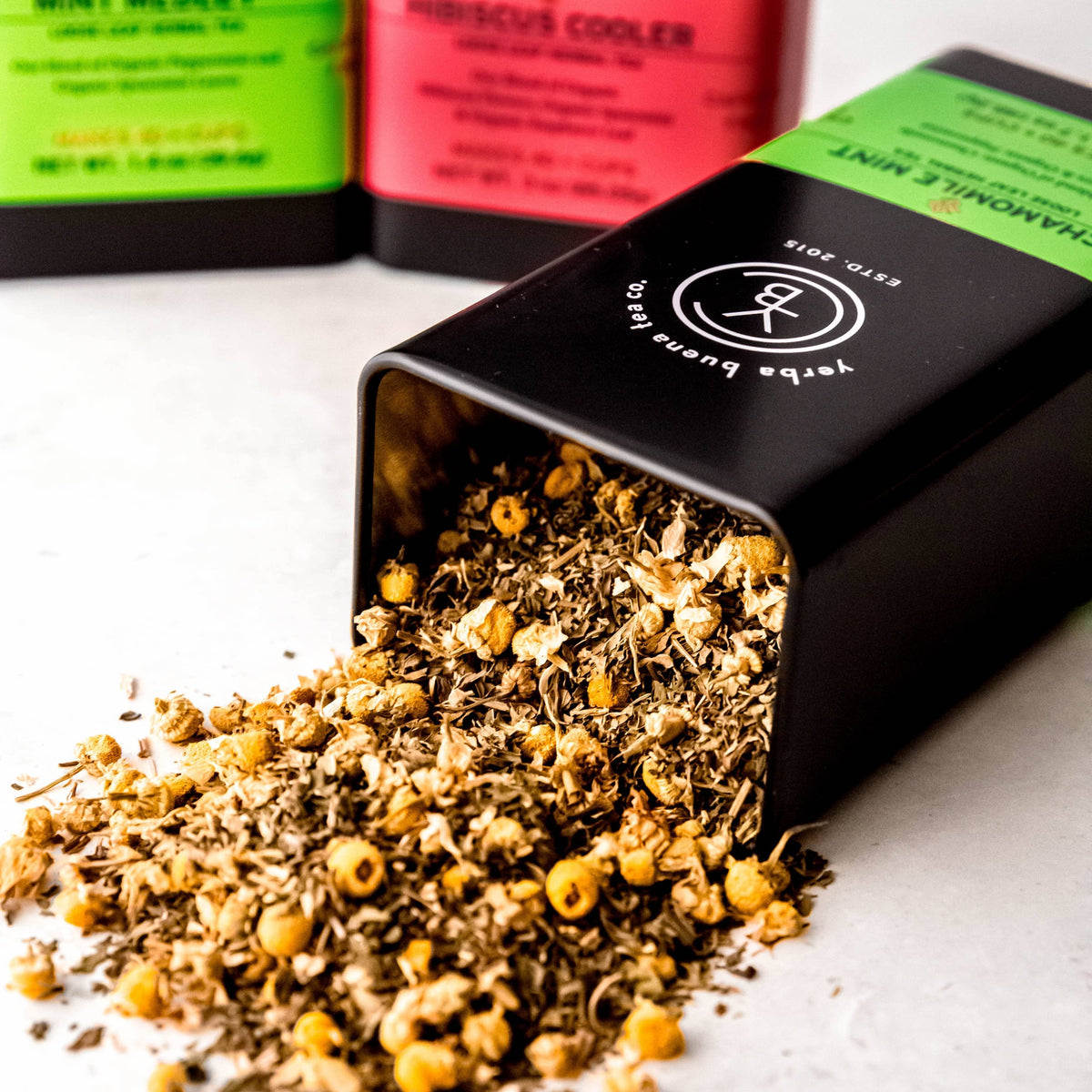
If it doesn't come from the Camellia sinensis plant, it's technically a tisane, an herbal infusion. Chamomile comes from the daisy family and has been used in Egyptian and European herbalism for centuries. Peppermint is a Mediterranean mint. Rooibos is a South African shrub. These are entirely different plants from entirely different parts of the world. They share a preparation method with tea (steeping in hot water) but not a family tree.
We carry a wide range of herbal blends because they're delicious and naturally caffeine-free, not because they need the 'tea' label to earn their place on the shelf.
Frequently asked questions about the types of tea
How many types of tea are there?
There are five true teas, all from Camellia sinensis: white, green, oolong, black, and pu-erh. Many people count a sixth, herbal tea, though herbal infusions are technically tisanes from other plants. So you'll see tea described as either five types (the true teas) or six families (the five plus herbal).
What are the 6 types of tea?
Two different lists get called the six types. The most common: white, green, oolong, black, pu-erh, and herbal. The more traditional Chinese classification swaps herbal for yellow tea, a rare style similar to green tea but with an extra slow sealed-yellowing step that softens the grassy edge. We focus on the five true teas plus herbal, since that's what most drinkers actually reach for.
Which type of tea has the most caffeine?
As a rule, fully oxidized black tea and pu-erh carry the most caffeine, green and white sit lower, and herbal tisanes are caffeine-free. But your cup matters more than the category: water temperature, steep time, and leaf amount move caffeine more than the type alone. (We break the numbers down in our caffeine guide.)
What is the best type of tea for a beginner?
Start with a forgiving, flavorful cup. A malty English Breakfast or a smooth Honey Rooibos is hard to oversteep. From there, explore by mood: bright and grassy (green), bold and warming (black), or soft and floral (white). Not sure? Our Find Your Tea quiz points you to a match in under a minute.
Why does organic matter for tea?
Unlike most produce, tea leaves go straight from the field to your cup without being washed. Whatever is on the leaf ends up in your water. Conventionally grown tea can carry residues into every steep.
That's why everything we sell, all 60-plus blends, is made with certified organic ingredients. That was never a marketing choice. It's the only version of the product we're comfortable putting our name on.
Ready to pick one? Shop tea by type to browse every family, or jump straight to the full collection of organic loose-leaf blends, hand-blended in Salem, Oregon.